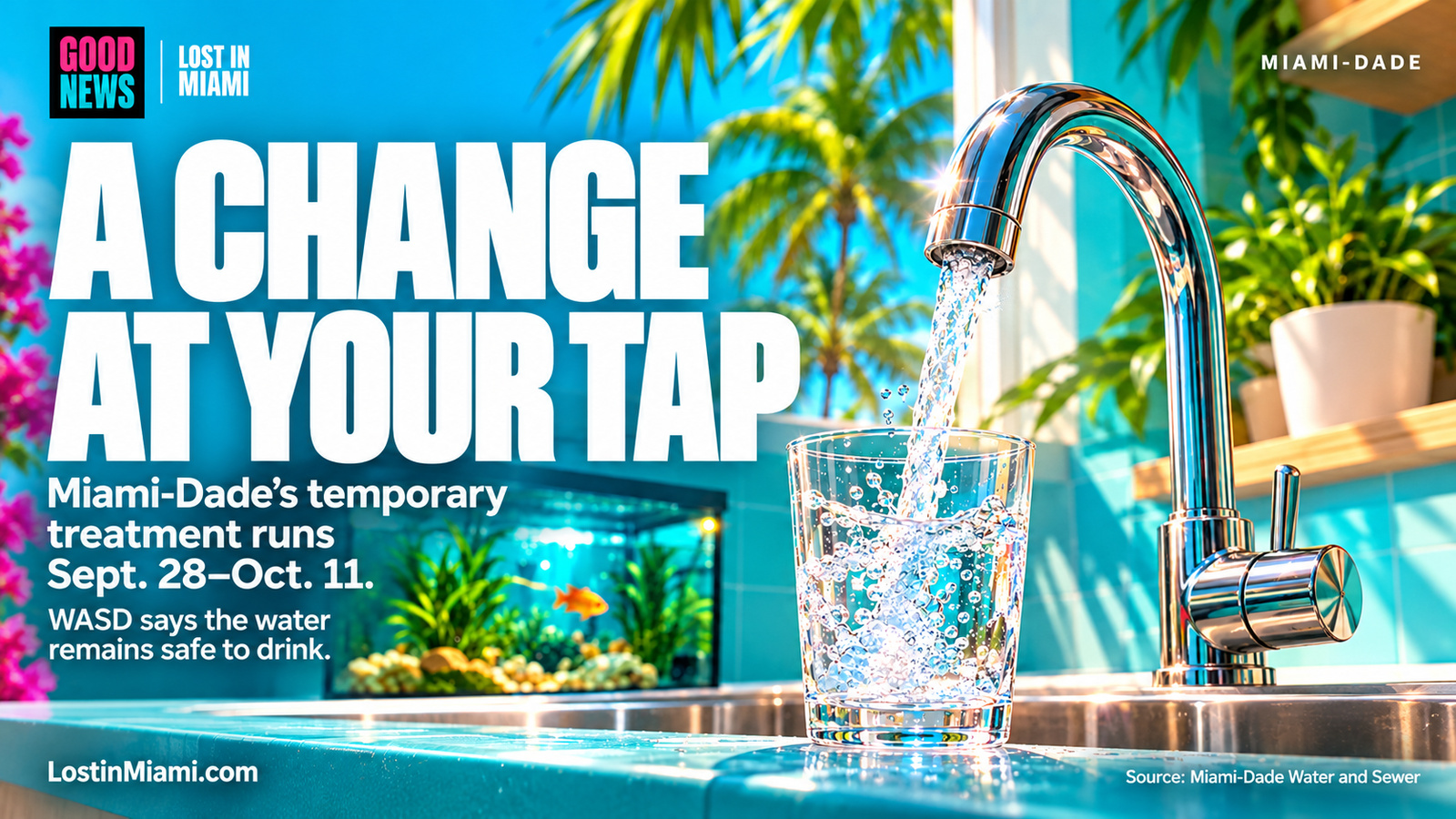
Miami-Dade Water and Sewer began a temporary countywide change in drinking-water disinfection on September 28, replacing chloramine with free chlorine through October 11. The department describes the two-week conversion as a routine system-maintenance practice intended to keep the distribution network in good condition.
Most residents do not need to take action. The county says the water remains safe to drink and continues to meet federal and state standards. Some customers may notice a stronger chlorine smell or taste. Employees will also flush lines around the county, which can briefly lower water pressure or make tap water look cloudy.
If the water is cloudy, Miami-Dade advises running the tap for three to five minutes until it clears. The department calls that appearance a temporary cosmetic issue rather than a water-quality failure. If cloudiness persists or is accompanied by another concern, residents can contact the county instead of guessing.
Two groups should pay closer attention. Dialysis patients may want to contact their doctor or treatment provider because dialysis systems have specific water-treatment requirements. Owners of tropical fish—and restaurants or stores that maintain fish-holding tanks—should consult an aquarium-maintenance professional. Chlorine can affect aquatic systems even when tap water is safe for people.
This is a Miami-Dade Water and Sewer operation, not a boil-water notice. It also does not mean every household will experience the same change. Odor and pressure can vary by location, plumbing and nearby flushing activity. Residents should not spread a photo of one cloudy glass as proof of a countywide contamination event.
For water-quality questions, the county directs customers north of Southwest Eighth Street to its laboratory at 786-552-4738. Customers south of Southwest Eighth Street should call 786-552-4181. Those are the practical numbers to save while the conversion is underway.
Public-health communication works best when it is specific. The relevant facts here are the dates, the disinfectant change, the possible temporary effects and the limited groups with additional precautions. The county says the annual maintenance does not create adverse health effects for the general population.
Apartment residents should start with building management if the issue appears limited to one property, because private plumbing can create conditions that are separate from the county’s distribution system.
Still, people should use judgment. Anyone experiencing symptoms should seek medical advice rather than assuming tap water is the cause, and anyone seeing an unusual color, persistent odor or sustained pressure loss should report the condition to the utility. The maintenance window ends October 11, after which Miami-Dade says it will return to its usual chloramine process.
Sources
Featured artwork: original editorial illustration.