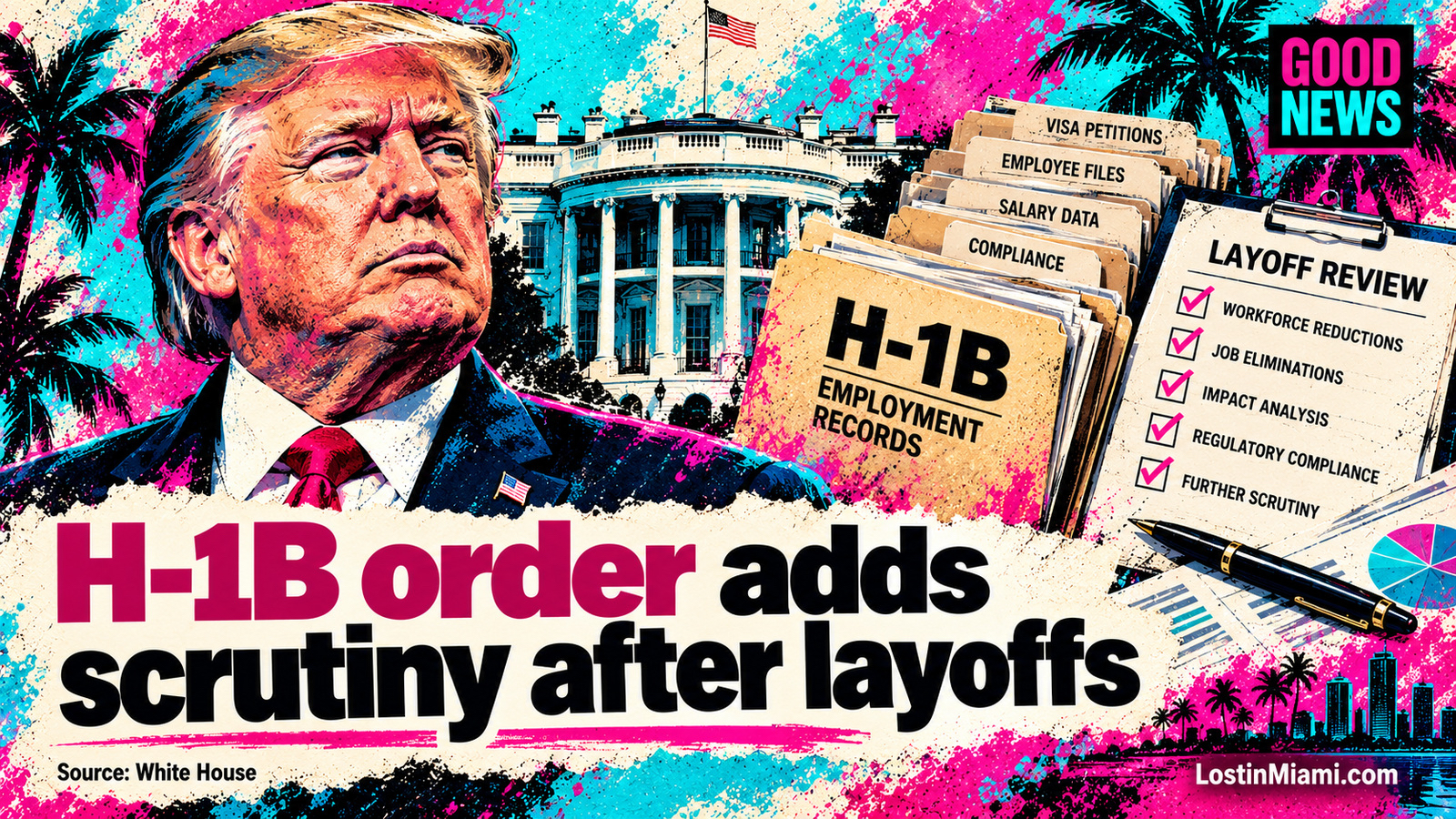
Employers pursuing H-1B workers face a new federal directive to scrutinize how those requests relate to layoffs. An executive order signed September 18, 2026 directs agencies to consider recent or planned job cuts affecting similarly situated U.S. workers when reviewing H-1B applications, petitions, visas and entry.
The order tells the Departments of State, Labor and Homeland Security to coordinate with Commerce, Education and the Small Business Administration. The additional agencies are to contribute relevant wage, employment, academic and economic information. This is a verified action from the past seven days, not a newly announced hiring count or a measure of how many jobs have already changed. Executive order
The layoff provision covers the previous year as well as planned future reductions. A separate instruction gives the Labor Department 30 days to begin reviewing data from previously submitted labor condition applications to determine whether further action is warranted. Beginning a review is different from finishing one or finding a violation.
The administration frames the order as a response to misuse of the visa program and displacement of American workers. Those are the administration’s stated reasons. They should not be read as a finding that every employer using H-1B workers has violated the law, or that a foreign worker is personally responsible for an employer’s layoff decision.
Erickson Immigration Group’s September 19 analysis highlights several limits. It says the order does not impose an outright ban on filings after layoffs, establish a specific new labor-market test or explain exactly how agencies will weigh the cuts. It also does not eliminate the H-1B program or automatically deny every petition connected to an employer that has reduced staff. Erickson’s legal analysis
That distinction is important for workers reading a sharp headline between job applications. A directive to examine evidence is not the same as a universal eligibility rule. The actual effect will depend on implementation, the facts of a case and applicable law. This article does not report a newly verified injunction against this particular order.
Our workforce analysis: hiring and restructuring can no longer be discussed as entirely separate administrative files when the directive explicitly links them. Employers and affected workers will need clear explanations of which positions are considered comparable and which records agencies expect.
For South Florida’s international workforce, the immediate value is knowing what changed and what remains unresolved. Do not assume a pending case has been approved, denied or cancelled because of this announcement. Case-specific decisions belong with qualified counsel and official notices. This is general reporting, not legal advice.