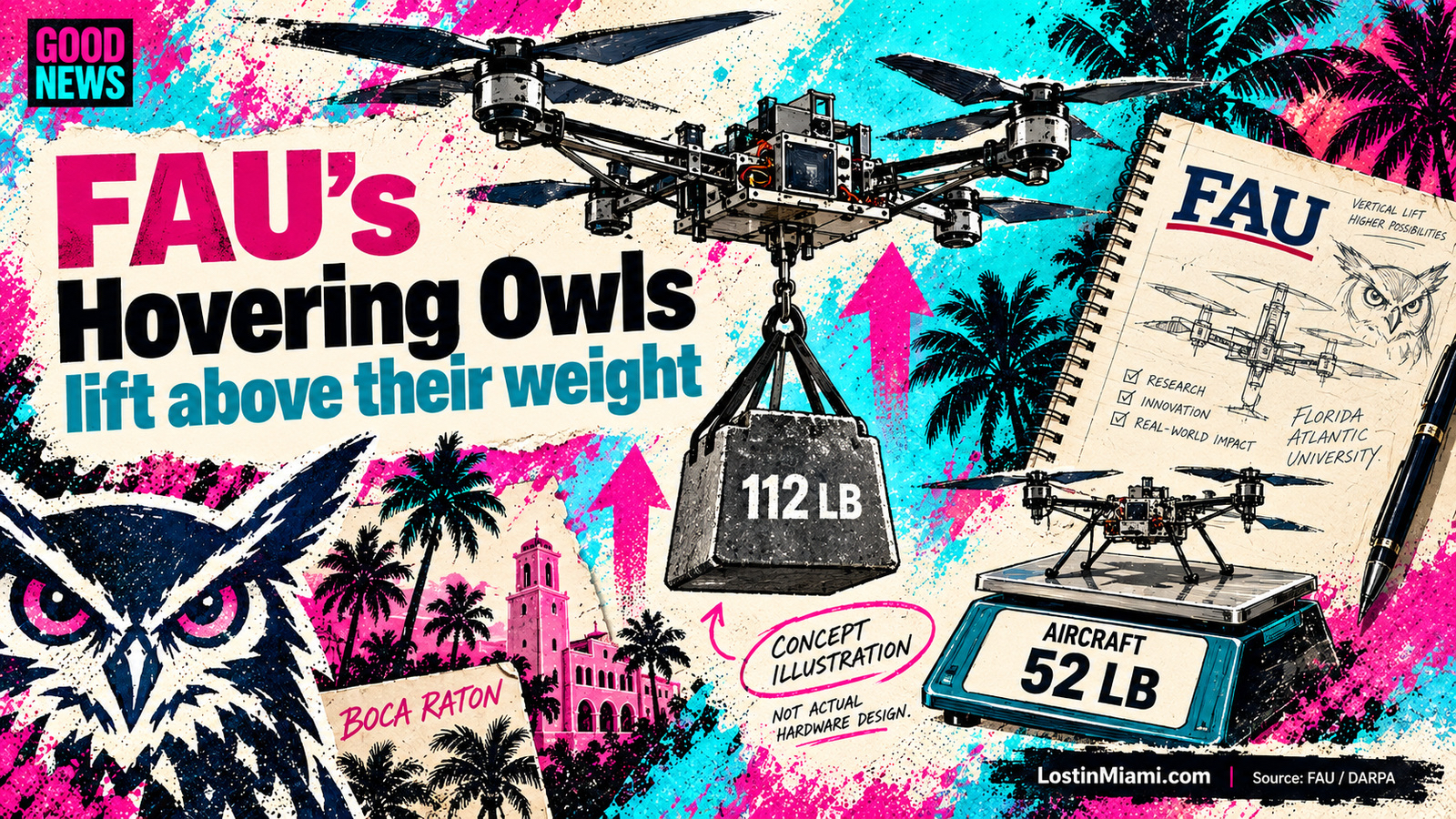
Florida Atlantic University has a new engineering achievement to put on the board: its Hovering Owls team demonstrated an aircraft carrying more than twice its own weight at DARPA’s Lift Challenge.
In a September 18, 2026 announcement, FAU said the team’s 52-pound autonomous aircraft lifted a 112-pound payload, producing a reported payload-to-weight ratio of 2.16 to one. The university said it was one of only two university teams to exceed a two-to-one ratio. The announcement is recent; the competition itself took place in August, not this past weekend. FAU’s September 18 report
The team belongs to FAU’s Center for Connected Autonomy and Artificial Intelligence within the College of Engineering and Computer Science. Its work connects the Boca Raton university to a national effort to rethink how much useful cargo small aircraft can carry.
There is an important distinction in the result. FAU said its team cleared the required safety checks and completed a qualifying run. The university did not report winning the overall competition. Only five industry teams completed scored runs, according to its account. Calling the Hovering Owls the overall champion would turn a genuine achievement into an inaccurate claim.
DARPA describes the broader challenge as an effort to push vertical-lift designs beyond the payload limits of conventional multirotor aircraft. The 2026 event used a five-nautical-mile circuit at the National Museum of the U.S. Air Force in Dayton, Ohio. Its ambitions include military applications as well as possible civilian uses such as logistics, infrastructure work and disaster response. Those are development goals, not evidence that FAU’s aircraft is already operating commercial deliveries. DARPA Lift Challenge overview
DARPA now says a second competition is planned for summer 2028, with aircraft still limited to 55 pounds or less, a minimum payload of 220 pounds and a longer course. That gives the first event a useful context: it was a technology challenge intended to push further research, not a finished-product launch.
Our take on the educational significance: engineering competitions reward more than an appealing concept drawing. A design must survive weighing, safety review and the practical difficulty of getting a load airborne. The distinction between qualifying and scoring also gives students a clear picture of where further work remains.
For Boca Raton readers, this is a local-university story with a national testing ground. The achievement is worth celebrating precisely as documented: a strong payload demonstration and one of the better university ratios reported by FAU. The next milestone will be independently documented progress in endurance, control and repeatable performance—not a bigger adjective in a headline.