
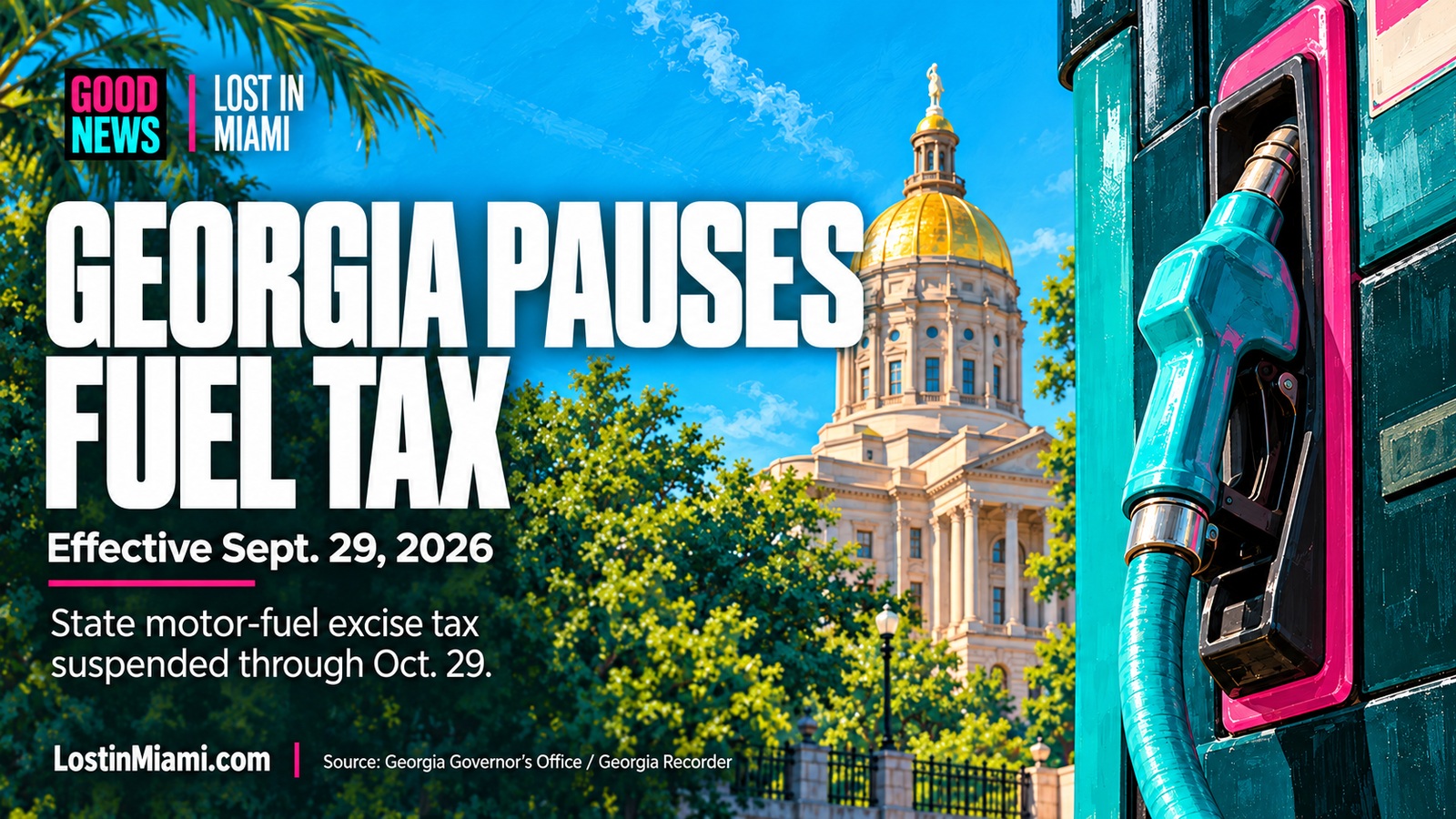
Georgia’s temporary suspension of its state motor-fuel excise tax took effect at 12:01 a.m. on September 29, 2026. Governor Brian Kemp announced the action September 28, with the suspension scheduled to run through October 29. It is an operative temporary measure, not merely a proposal.
The governor’s office lists the affected excise-tax rates as 33.3 cents per gallon for gasoline and 37.3 cents for diesel. Those figures describe the state tax being suspended. They should not be presented as a guaranteed reduction in every station’s posted retail price.
Kemp’s announcement tied the action to global market volatility and a declared state of emergency. Georgia Recorder separately reported the executive action and the same end date. The governor’s stated rationale is relevant context, but it does not establish that one policy can control all the factors affecting fuel prices.
For a simple illustration, the suspended gasoline tax would equal approximately $5 on 15 gallons if the full amount were reflected in the price paid. That is arithmetic using the announced tax rate, not a forecast of a particular driver’s savings. Actual transactions depend on the price charged at the station and how that price changes over time.
This is where the distinction between a tax change and a price promise matters. A tax is one component of the retail cost. Removing it temporarily does not freeze the remaining components, guarantee identical pricing across retailers or prevent a posted price from moving for other reasons.
For Florida readers driving into Georgia, the relevant jurisdiction is the place where the fuel is purchased. The announcement concerns Georgia’s state excise tax; it is not a change to Florida’s fuel taxes. A South Florida travel budget should therefore use actual prices along the route rather than applying the Georgia adjustment to every gallon bought during a trip.
The dates also deserve a calendar entry for businesses that closely track fuel expenses. The measure has a stated October 29 endpoint. An extension, early change or new measure would require a separate official update. We are not assuming that a temporary suspension will become permanent.
The immediate value of clear reporting is predictability about the rule, even when the final pump price remains uncertain. The practical next step is to compare current posted prices and retain the suspension’s end date when planning expenses. The confirmed development is a month-long pause in Georgia’s motor-fuel excise tax, with actual retail prices still subject to change.
Sources
Video: No verified embeddable video available