

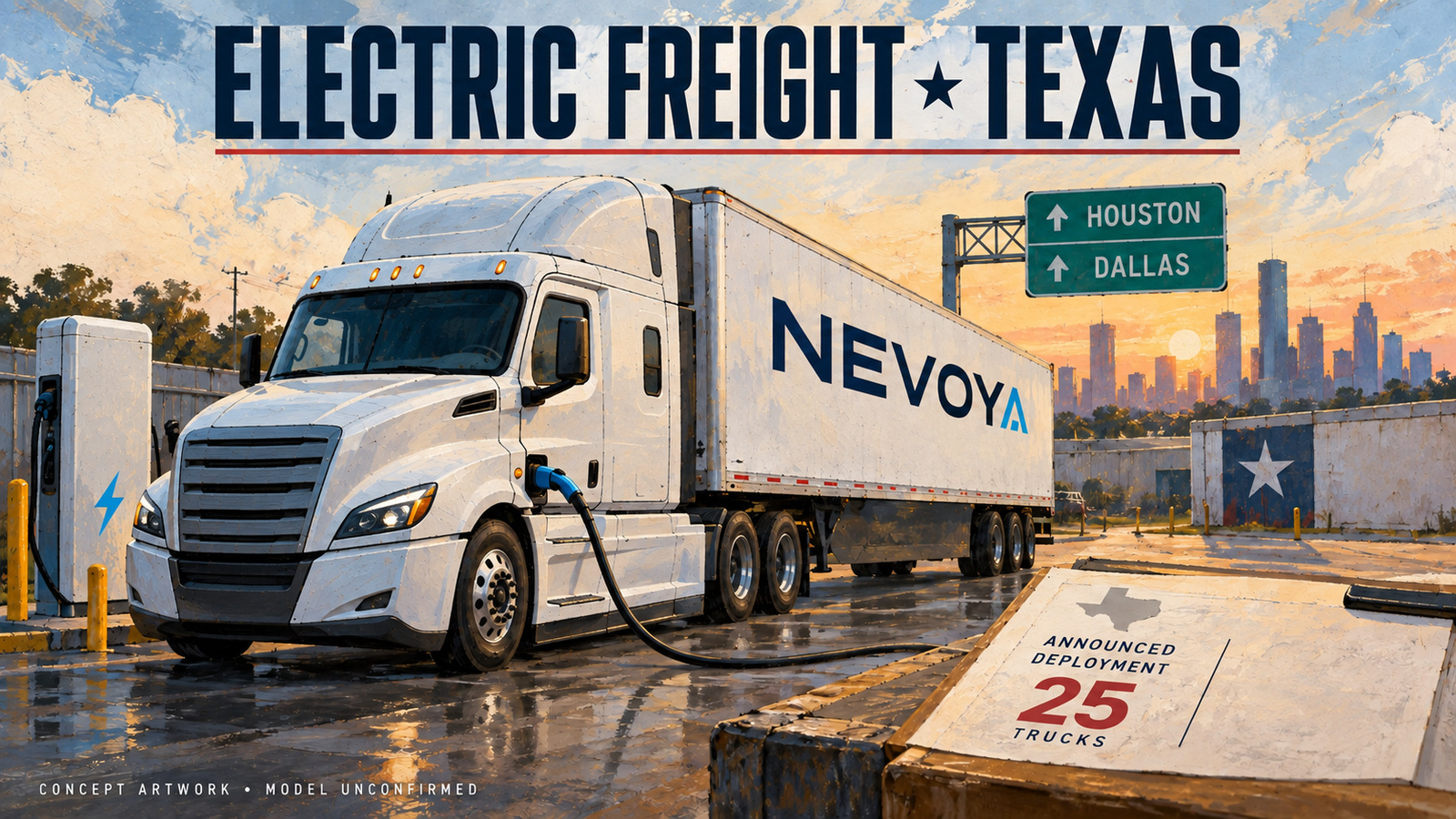
Electric trucking needs more than a promising vehicle. It needs freight to move, somewhere to charge and a business arrangement that makes the investment workable. A newly announced Texas partnership addresses those pieces together.
Google said September 8, 2026 that it is partnering with electric carrier Nevoya and the Center for Green Market Activation to deploy 25 electric semi trucks and associated charging infrastructure on a Houston–Dallas route. This is an announcement from the previous seven days, not a claim that a new fleet began service tonight. Google announcement
Google will receive environmental attribute certificates associated with the project. These certificates represent environmental benefits; purchasing them is not the same thing as purchasing the trucks or becoming their operator.
The company places its contribution within a larger 63-truck project. It projects approximately 11 million annual miles and an estimated 92,000 metric tons of avoided carbon-dioxide-equivalent emissions across the contracts’ duration. Those figures describe the overall project and modeled benefits, not 25 trucks’ independently measured results. Google announcement
Trade publication electrive separately reported the partnership on September 9. Nevoya identifies itself as a fully electric carrier serving shippers and third-party logistics companies. That operating role matters: the partnership combines a freight carrier, a market-development organization and a corporate purchaser of environmental benefits. electrive Nevoya
Our industry analysis is that the route is the useful unit of discussion. A truck’s suitability depends on the work it must do, and a charging plan only becomes meaningful when it fits that work. Looking at the vehicle in isolation leaves out much of the operating question.
For carriers and owner-operators watching the announcement, the relevant follow-up is not whether every diesel truck should immediately be replaced. It is whether this particular arrangement can deliver dependable service, charging access and economics that hold up over time.
The certificate structure also deserves attention. A company can support lower-emission transportation through a purchasing agreement without every shipment in its own supply chain physically riding on that exact vehicle. Clear accounting is essential so the same benefit is not casually described as several different achievements.
None of the reviewed announcements supplies a universal cost-per-mile figure that other fleets can assume will apply to them. Nor does an estimated emissions reduction establish the full environmental footprint of manufacturing vehicles, generating electricity or building facilities.
A credible next chapter would document actual deployment, miles traveled, charging performance and the method used to account for the benefits. Those are the kinds of results that can help the wider industry evaluate a model rather than simply admire an announcement.
The near-term news is concrete: Google is backing a defined electric-freight project in Texas. Whether it becomes a repeatable model will depend on the operating evidence that follows.


