
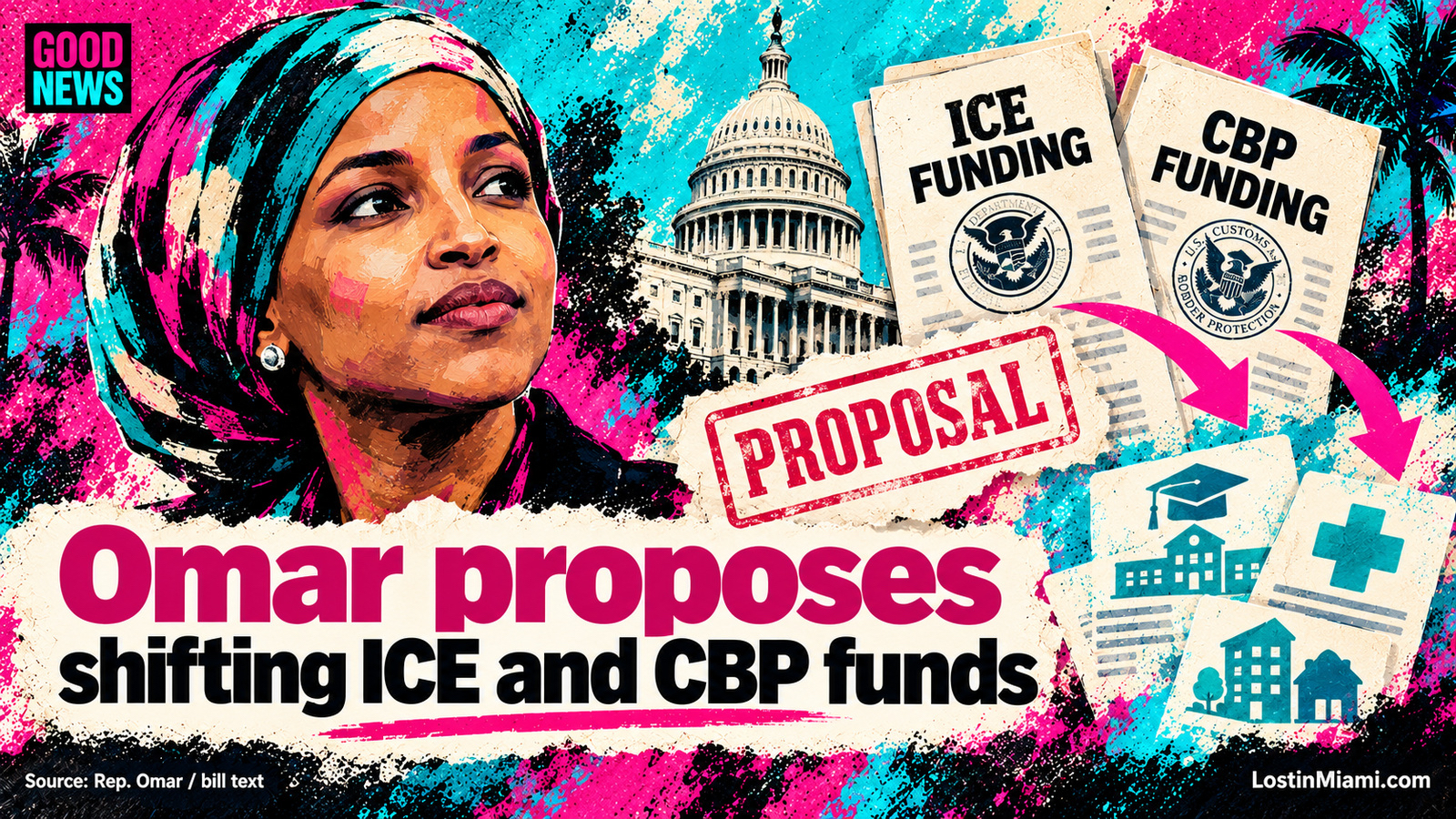
Representative Ilhan Omar has proposed a major shift in federal immigration spending: moving approximately $139.6 billion from funds allocated to Immigration and Customs Enforcement and Customs and Border Protection into a program intended to reimburse communities affected by immigration-enforcement operations.
Omar’s office announced the Make ICE Pay Act on September 17, 2026. The proposal is this article’s dated development from the past seven days. It is not enacted law, and the announcement does not create an application window for households, businesses or local governments. Omar’s announcement
The office presents the measure as a response to economic and community damage it attributes to enforcement surges, including Minnesota’s Operation Metro Surge. Those characterizations are the sponsors’ arguments for the legislation, not findings established by this article. The announcement names six cosponsors, including Representatives Angie Craig, Chuy García and Chellie Pingree.
The posted bill text makes the proposed mechanism more specific. It would transfer $139,575,630,000 from ICE and CBP funding under Public Law 119–21 to the Department of Housing and Urban Development. HUD would establish the reimbursement program within 60 days after enactment. That clock would begin only if the measure became law. Posted bill text
The draft lists Minnesota, California, Illinois, Louisiana, Maine, North Carolina and Oregon as eligible states. Florida is not on that list. Proposed criteria include lost economic activity, local-government costs and community harm. The text also provides for funding through eligible nonprofits for purposes including education, healthcare and certain local-government costs.
For Miami-area readers, the geography is an important guardrail. A national headline mentioning grants and small businesses does not mean a North Miami or Miramar business can apply. There is no verified application portal for this proposal, and readers should be cautious of anyone selling access to one.
The policy choice is substantial. Supporters are asking Congress to redirect money away from enforcement and toward the costs they say enforcement has imposed. Evaluating that choice requires examining how losses would be documented, who would administer payments, what oversight would apply and what the transfer would mean for the agencies losing the funding.
Those are questions for the legislative process, not assumptions this edition can resolve. Introducing a bill establishes a position and a proposed legal mechanism; it does not establish that Congress supports it or that payments will occur.
The next meaningful developments would be an official bill record, committee action, amendments or votes. Until then, the accurate description is a consequential spending proposal with a defined list of potential state recipients—not a completed transfer of federal money.