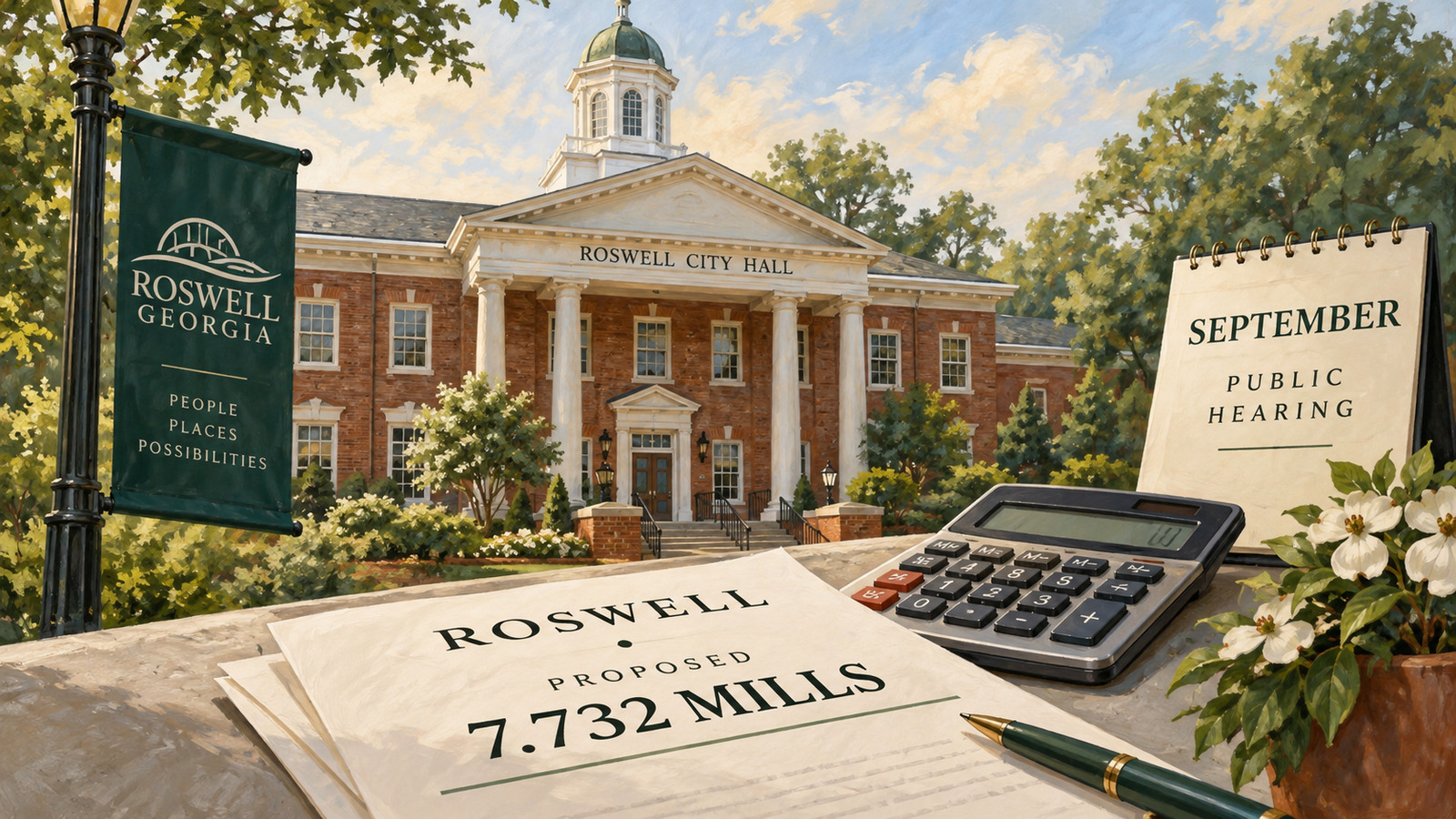
Roswell residents are challenging a proposed increase in the city’s property-tax millage rate after a September 14 council meeting drew objections. WSB’s September 15 report describes concerns about affordability and city spending as officials consider moving the rate from 4.949 mills to 7.732 mills. The proposal has not been adopted. WSB report
That change is approximately 56.2% in the city rate. It is not a 56.2% increase in every homeowner’s entire property-tax bill. Roswell residents also pay taxes to Fulton County and its school district, and the impact on a particular property depends on taxable value and applicable exemptions.
One mill represents one dollar per $1,000 of assessed value. Using the city’s illustrative assessed value of $230,000, the old rate produces $1,138.27 in city tax before exemptions; the proposed rate produces $1,778.36. The difference is $640.09 in this example, not a personalized estimate for every household. City tax information
City officials say additional revenue would support road and infrastructure work, aging facilities and equipment, and public safety. That is the administration’s explanation for the proposal. Residents’ objections about spending priorities and affordability are part of the policy dispute, not evidence that any allegation of waste has been established. City explanation
There are further opportunities to question the plan. The city lists a September 16 town hall from 6–7:30 p.m. at Eagles Nest Church, 2342 Holcomb Bridge Road. A public hearing is scheduled for September 21 at 6 p.m., followed by a planned second reading and adoption on September 28 at 7 p.m., both at City Hall, 38 Hill Street.
“Planned adoption” describes the calendar, not the outcome. The council can still debate the proposal, and residents should use the current official meeting information before attending.
Our analysis: the most productive budget questions connect an amount to a service. Which projects would receive the additional revenue? What happens if the rate is lower? Which expenses recur annually, and which are one-time investments? Those questions make it easier to compare alternatives than arguing over a percentage alone.
Homeowners should also keep assessed value separate from market value when doing their own arithmetic. An exemption can change the taxable base, and a broad news example cannot account for every property’s circumstances. Review the actual assessment and city guidance before treating a calculation as a bill.
The immediate story is public resistance to a substantial proposed city-rate increase, with more meetings ahead. The next decision has not happened yet. That leaves residents time to examine the numbers and put specific questions on the record.