
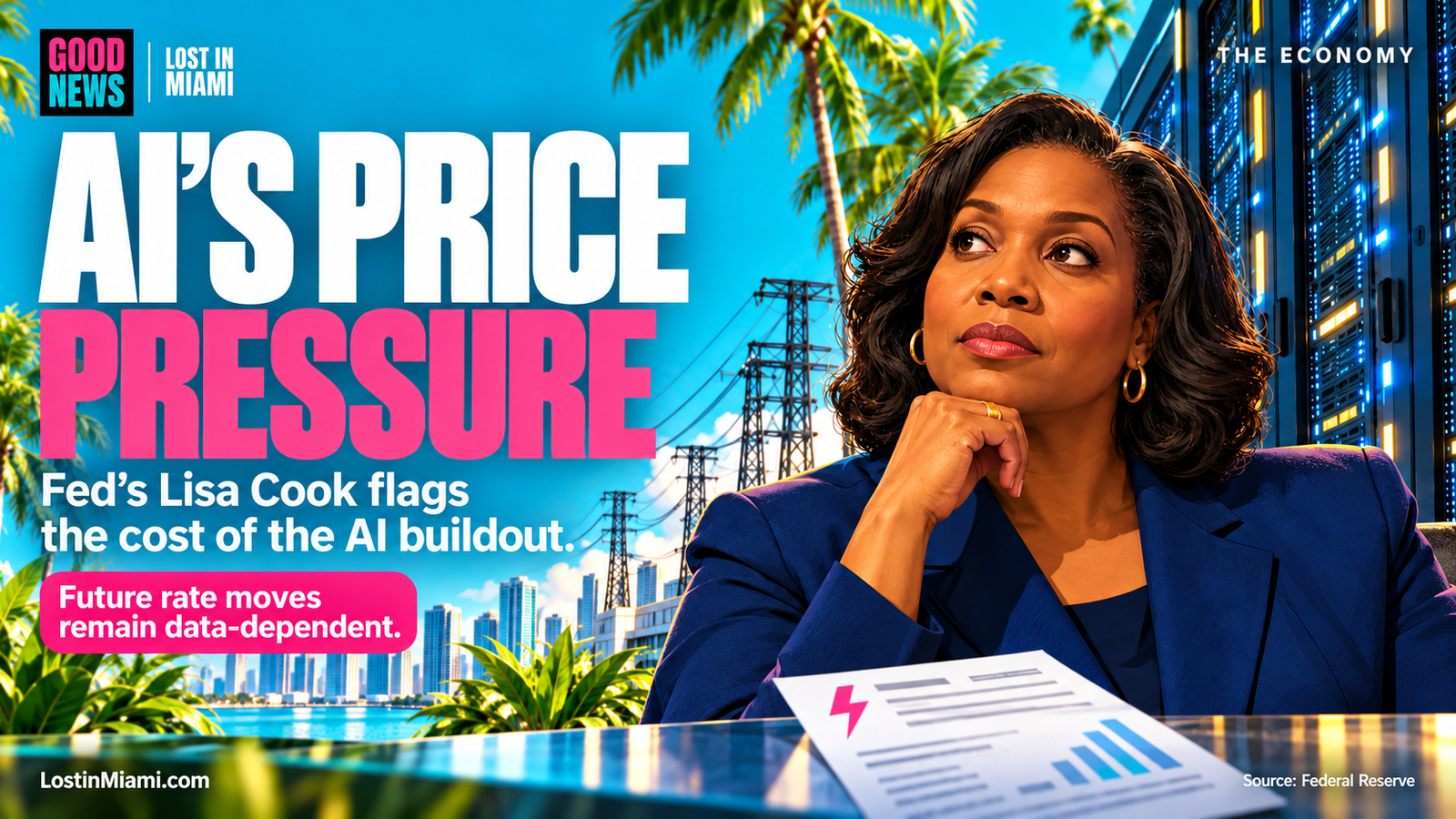
Artificial intelligence may eventually make the economy more productive, but Federal Reserve Governor Lisa Cook says the buildout is creating price pressure now. In a September 28 speech at Oakland Tech Week, Cook described AI as a general-purpose technology with enormous long-term promise—and a short-term inflation problem policymakers cannot ignore.
Her argument starts with concentrated demand. Spending on chips, computers, software, data centers and the electricity and water that support them has pushed hard against limited supply. Cook pointed to electricity and water costs each rising about 5% over the past year and said core-goods prices have been running above a 3% annual pace so far this year. She presented AI as one possible contributor, not the sole cause of every increase.
Productivity could eventually work in the opposite direction. If businesses produce more with the same resources, that added supply can relieve price pressure. But Cook said the timing is uncertain: companies must adopt the tools broadly, redesign work and pass gains through to prices. Market concentration and higher profit margins could weaken that effect.
The labor-market question is just as complicated. Cook said AI could reorganize work on a generational scale, creating new roles while eliminating or reshaping others. A temporary rise in unemployment caused by workers’ skills not matching available jobs would be difficult for the Fed to address. Cutting rates might support demand, but it would not directly solve a skills mismatch and could reignite inflation.
Cook also placed the AI story inside a hotter overall outlook. She said total inflation was estimated at 3.8% in the 12 months through August and core inflation at 3.4%. She voted with the rest of the Federal Open Market Committee to raise rates by a quarter point at its September meeting, citing inflation that remained above the Fed’s 2% goal. She also identified higher oil prices and supply-chain disruption tied to the Middle East conflict as near-term pressures.
This was not a promise of another increase. Cook said the number and size of future rate adjustments will depend on how the economy reacts and on incoming inflation and labor data.
For households and small businesses, that means the AI boom is not just a tech-sector headline. It touches utility demand, equipment prices, hiring and borrowing costs. The Fed’s challenge is to look past the hype in both directions: neither assuming an instant productivity miracle nor dismissing the long-run gains. The next rate decision will still turn on measured data, not one speech.
Sources
Featured artwork: original editorial illustration.