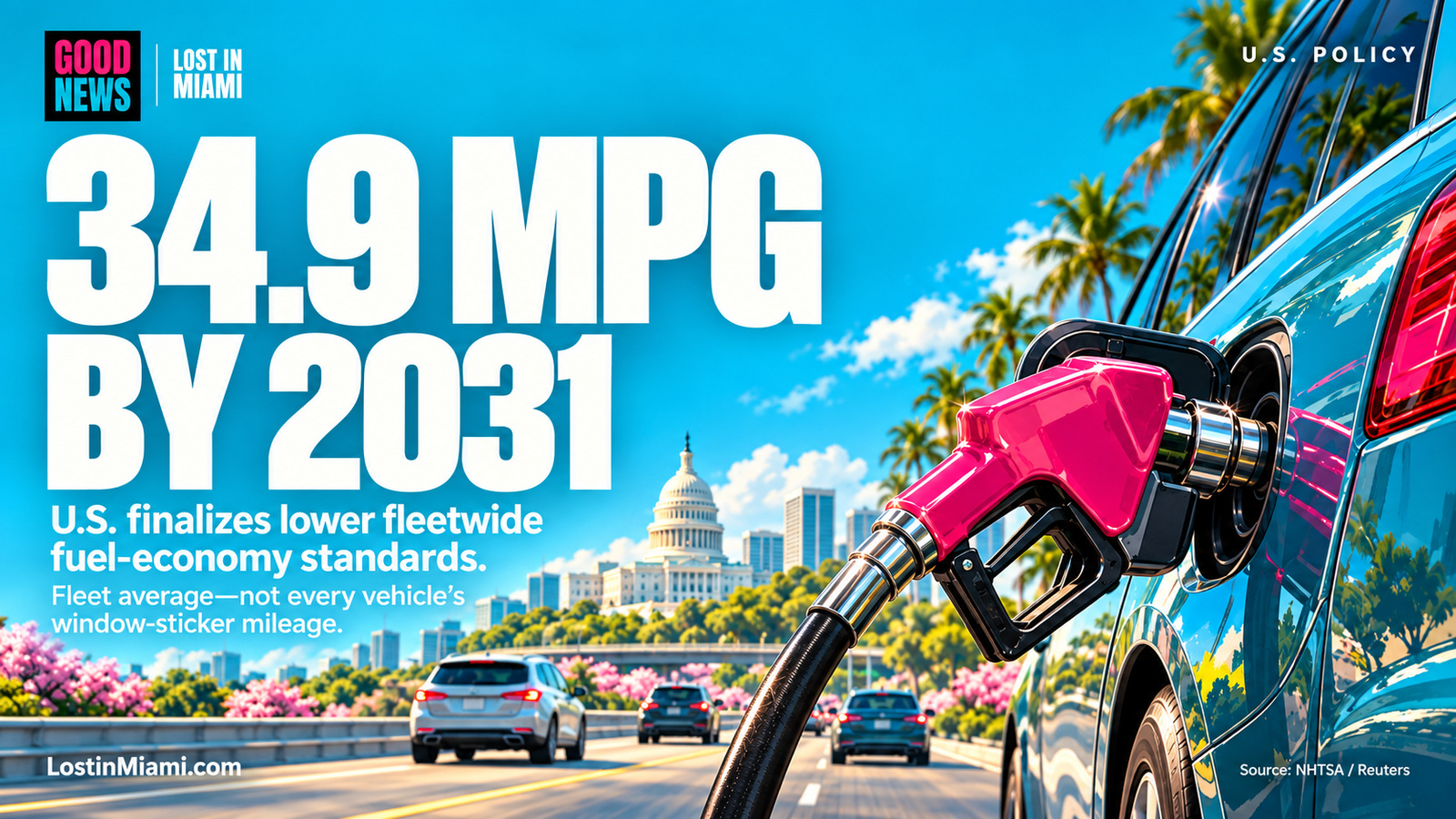
The Trump administration finalized a major reset of federal fuel-economy policy on September 28, setting standards that NHTSA projects will correspond to an industrywide average of roughly 34.9 miles per gallon in model year 2031. The prior rule aimed for 50.4 mpg.
The final rule covers passenger cars and light trucks for model years 2022 through 2031. It also ends inter-manufacturer fuel-economy credit trading beginning in model year 2028 and changes how some vehicles will be classified starting in 2030. Those details matter because automakers comply across fleets, not by making every vehicle hit one identical number.
The administration’s case is affordability. The Transportation Department estimates manufacturers’ average compliance cost will fall by $1,289 per vehicle and says the changes will support new-car sales. The Alliance for Automotive Innovation, whose members include major U.S. and global manufacturers, praised the rule as a better match for current market conditions and the law.
The government’s own analysis also identifies a cost on the other side. Reuters reports the department estimates more than $1,600 in additional fuel expense over a vehicle’s lifetime and 4.6% more U.S. gasoline consumption through 2050 compared with the prior standards. Lower upfront compliance cost and higher operating cost are not mutually exclusive; both can land on a household at different times.
Environmental groups oppose the change. The Sierra Club said it would fight the rollback, arguing that it increases pollution and shifts cost to drivers. Supporters counter that the former trajectory pushed the market toward electric vehicles faster than consumer demand and charging infrastructure could sustain.
This is a finalized rule, not a campaign proposal. Its real impact will still unfold through automaker product plans, litigation, consumer demand and future administrations. A fleetwide compliance figure is also not the same thing as the mileage shown on one vehicle’s window sticker, and real-world fuel economy varies with driving conditions.
For buyers, the practical question is total cost. The sticker price, financing rate, insurance, expected fuel expense and how long a vehicle will be kept all matter. A lower-cost vehicle can still be more expensive to operate, while a more efficient model may not make sense for every commute or budget.
The political divide is clear: the administration is prioritizing near-term vehicle affordability and manufacturer flexibility; opponents prioritize fuel savings, emissions and public health over the vehicle’s life. The next checkpoints are the rule’s effective date, legal challenges and the 2028 end of credit trading.
Sources
Featured artwork: original editorial illustration.